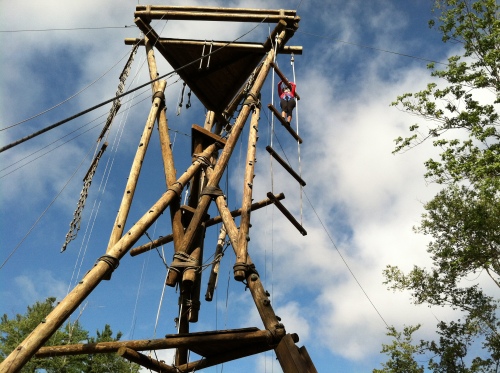
 The tower was a medieval-looking structure – a tripod constructed of massive timbers which looked like over-sized telephone poles. Wrapped with ropes the thickness of my upper arm, the structure rose into the grey afternoon sky. There were climbing holds stapled along the legs at various points, and climbing ropes draped from its height. There was a platform on top where one could stand and look out over the Connecticut countryside.
My first impression was that it looked like a siege weapon from a Lord of the Rings movie, only missing a few attendant orcs. It was at once challenging and forbidding. And the closer I walked toward it the more uncomfortable I felt.
It was the afternoon break during a conference. Participants could snooze, chat, read, play ball or –as in my case — check out the “ropes course.” But this was unlike any challenge course I had seen. Instead of cables strung between treetops there was this lone structure in a field, tended by a staff of three whose task it was to ensure the safety of climbers who would ascend while belayed in harnesses.
I was the first to arrive, and wandered below the three-legged device. I looked up and felt slightly dizzy. No one had come to climb the tower yet, and I had no intention of trying to climb it. My plan was to hang out and watch more valiant souls do it.
Being curious, I peppered the climbing safety team with questions, such as who made the tower, how it was used, and how safe it was. Admittedly, deep down, I had always wanted to address my own long-standing fear of heights. Sure, I’d had limited encounters with vertical space, such as clambering up the Forehead of Mount Mansfield in Vermont and scaling Katahdin in Maine. But those, while risky, never involved as much anxiety as the notion of climbing this tower seemed to stimulate.
After a few questions, one team members offered a candid comment. “Even kids love climbing this thing,” she said. OK, I could understand how fearless children, restrained with rope and safety harness, would not hesitate to tackle this over-sized Tinker Toy. But then came the clincher.
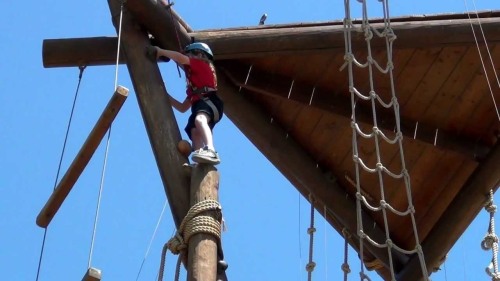
“They even climb it blindfolded!”
They climb it — blindfolded?”
The statement stunned me. How gutsy was that? A troop of kids exuberantly clambering up a height without the benefit of sight to maneuver.
I kept walking around the tower, looking up. I checked to see if anyone else was coming to climb, but no one had yet arrived. I stared up once again, and kept walking around the looming structure. The climbing ropes trailing from the top battered against the timbers in the wind. I heard carabiners clink and bang together like wind chimes in a gale.
The notion of tackling a ropes course made my stomach twist in a knot. But the idea of doing it — sightless!?
Yet, there was something else beneath my amazement. Something that bothered me, which I could not uncover —
I stopped in my tracks, frozen in place by an experience I rarely have: what’s called an “Aha!” moment.
Of course! It was completely counter-intuitive to anything I’d experienced — the notion of tackling a long-held fear by simply subtracting an element of that fear — namely, sight.
Moments later I was breathing deeply to suppress my anxiety as I was strapped into a climbing harness and roped to the tower by the belaying team. My head swam with thoughts, my gut with emotion. I had just blurted out that I wanted to try a blindfold tower climb. I was amazed the words came out at all! But, I had crossed the Rubicon on this one, so I walked to the nearest timber and, with guidance, I slipped the blindfold over my eyes and reached out to feel for my first handhold.
My focus remained on moving up, working to discover my next gripping point with my right hand, and launching my body upward with my left leg. Any sense of anxiety evaporated as my concentration increased, and I alternated between pulling myself up with my hands while using my legs to push, and feeling for hand holds farther along the timber. I lost count of my maneuvers and put my effort and energy into scaling my way up. My breathing was steady but slightly labored, and – most of all – I noticed a remarkable absence of fear.
A few minutes later I paused to catch my breath. “How’s it going?” I heard a voice below me say. It was good to know my climbing team was keenly focused on my well-being. “Good,” I said. “I think I’d like to take a look around.”
Surprised, again, by my unexpected boldness, I used a hand to lift the blindfold so I could see. I was struck by my continuing absence of anxiety or fear. In fact, I marveled that the solution to my dread lay in simply doing something completely counter-intuitive.
Have I overcome my fear of heights since that pivotal experience? Not totally — but to a great degree. More importantly, I’ve learned there is more than one way to handle fear, and a means to manage it may be found by considering an outrageous-sounding, out-of-the-box solution.


 Photo courtesy of M & D Hills Adventure Photography
 It’s a question I’ve heard more than once lately. Usually, it’s in reference to the struggles people might be having dealing with the isolation precipitated from the Coronavirus “lockdown.” Now, with things “easing up,” I’ve heard, or seen written, the question — “Who will you be on the other side of the pandemic?” Or some variation thereof.


 Write in Front of Me